"Moss Agate" Is It Really Kralik Production?
by Craig Orkney
Where It Started
Early on though, one of the things that I did notice, which remains true to this day, is that the shapes the décor is found on are not shapes which are seen with other known or recognized Kralik decors. Many of the shapes are actually not seen in any other decors. This observation found me looking to see if I thought that possibly the décor had been incorrectly attributed. When I started that study, I had no preconceived notion of where the investigation would take me, or who the maker would be if it turned out to not be Kralik. I was simply curious. I also knew that the research would likely take a long time, as examples of Moss Agate are not all that common, and that it may never actually result in any type of conclusion on my part. So the snail paced investigation began.
In addition to the use of unique decors, my research like this also includes focusing on two avenues that have previously led to other research conclusions. I am always careful, and like to take as much time as necessary to arrive at a supportable conclusion. I never rush. My experience is that once an “attribution bell “ has been rung, it becomes next to impossible to “un-ring” it. That is a downside to the speed of the internet, and it's ability to disseminate information quickly.
One of the two avenues I focus on, is to locate examples of unique shapes which are infrequently seen, as they generally tend to point to a single production house. Many shapes are not distinct enough to use in this manner.
The other avenue can be the use of what I would classify as more common shapes, in terms of their form, but ones that are very infrequently seen. As an example of this, a simplistic form would be a “ball vase”, as made by many companies. This shape is quite simplistic, but is also quite commonly seen. So the search for simplistic forms, which are also uncommonly seen, but distinct enough to narrow a search, can also be quite useful.
My journey examining this décor and its origins, took advantage of both of these types of shapes. So let's look at what I found, and where it has taken me. This conclusion is the result of about 5+ years of study.
As I went about my Welz research, one of the first forms I ran across in Moss Agate that I found to be very curious was a shape in the form of a “Trophy Vase”. Although I did not recognize the shape as one I was familiar with, what I did know was that I did not know of any examples of “Trophy Vases” as such, that were attributed to Kralik production. I was curious that it did resemble in some ways, some trophy vases which I had attributed to Welz production. This image shows not only the Moss Agate example, but also shows a couple of Welz trophy vase examples which share some similar shapes and characteristics.
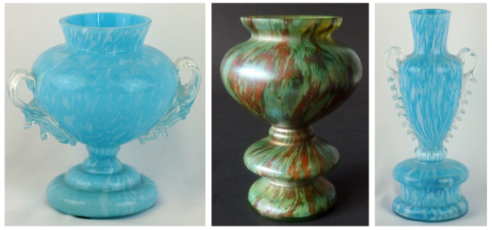
Having cataloged that shape, my search continued. Over the years almost all of the shapes I found Moss Agate in were shapes I did not recognize as having been seen in other decors. I have to admit that I always found that unusual. One of the more frequently seen details was that a number of those shapes displayed a detail referred to as “Humpen”, or teardrop shaped protrusions seen on the surface of varying shapes. I do know that the attribution of Moss Agate to Kralik had relied on the belief by the researcher that assigned the attribution, that shapes using Humpen were Kralik in origins. I do not know what that belief was based on though.
As time marched on, I continued to accumulate images of Moss Agate shapes and cataloged them.
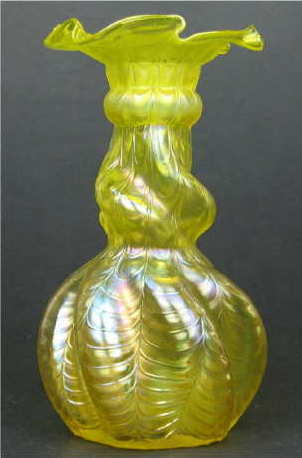
As part of my Welz research, one of the things I came to believe was that the “Draped” décor, declared by the same researcher to be Kralik, was actually a décor which was also produced by Welz. I believe both companies (and likely others) produced the décor. In determining that to be true, I found examples of draped which could be solidly linked to Welz production, and done in a very unique yellow glass I refer to as “Cadmium Yellow”. Among the seemingly mundane shapes I identified as Welz in Cadmium Yellow Draped, I came across a pretty unusual form found in that color and décor. In addition, the Cadmium example had the same rim crimp found on other examples of Welz production in the Passau Welz case. Most noticeably on the rim of two examples of the Draped décor seen in the same case. I would also note that a previous researcher had declared the draped examples in the Welz case to be Kralik production and not by Welz. That Cadmium Draped form is seen in this image.
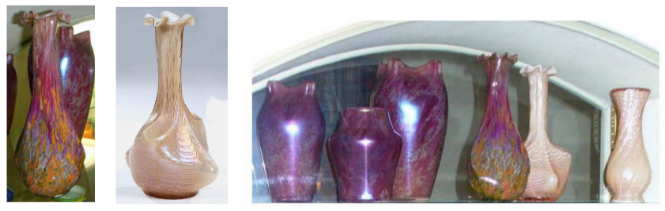
The same style of rim as used on the Cadmium draped example, is also seen on an example of Welz production in a décor produced using a Welz patented glass formula. This image shows the rim crimp on that vase on the left. The vase next to it is an example of the Draped décor with the same rim style. Both are seen in the Welz case in Passau. The right hand portion of the image shows the top shelf of the case.
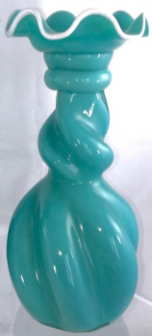
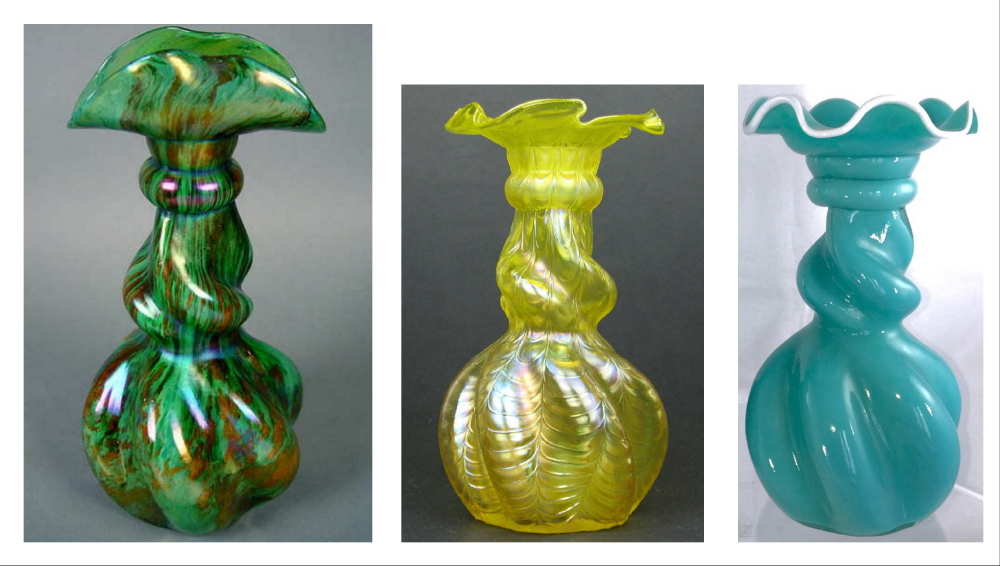
At that point in time, I did not really give it much thought, other than it seemed to add supporting evidence to my assertion that Welz also made pieces in the Draped décor. About a year later, I came across a very similar shape to the Cadmium Draped example, with a minor difference in the upper neck region below the rim, but the same basic shape. That example was in a light blue ground with a white trimmed rim. The piece also had a two line small font mark on the underside which read “Made In Czechoslovakia”. The mark is one that is commonly found on Welz production, and not found on Kralik attributed glass. It is not a mark I use to attribute Welz production, but it does help to support some of them. To me at least, this helped to confirm the shape as being Welz production. I had now seen three examples of this form. One in Cadmium Draped, and two in a blue ground with a white rim. This is that form.
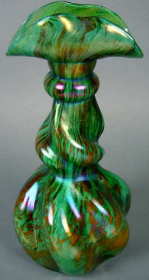
As my Welz research progressed I was made aware of a pair of vases purchased by a friend in Moss Agate. I was shocked to see the shape of the Moss Agate pieces. The Moss Agate shape was the same unique form see in the Draped and light blue ground. There were some small variations in rim design and upper neck, but the basic form was the same on these as the others. This pair of vases brought the number of pieces in this form to five. My opinion, was that the forms were certainly pointing towards Welz as being the source of the production. Knowing the “controversy” my claims of Draped and also Spiraloptisch being produced by Welz created, I continued to look for confirming evidence pointing to Welz as the source for Moss Agate production. At this point, I was several years into my study of Moss Agate. This is the Moss Agate form of the vase.
Here is a comparison of the 3 examples.
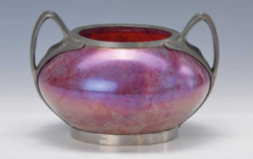
I previously mentioned a glass patent held by Welz. The Passau Welz case contains some examples of that décor. It is a décor which I refer to as “Purple Iridescent”. The patent was granted at the end of 1899. One of the shapes I have identified that décor on was a simple ovoid form vase found in a pewter mount. A very simple form, but in a very distinct décor. That example is seen in this image.
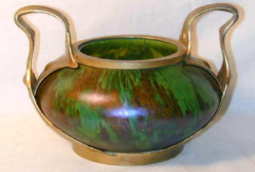
I then came across an example of Moss Agate, also in a pewter mount, which appeared to be the same basic form. That example is seen in this image.
Here is an image which compares the two forms side by side. Although the angle/distance that the two images are taken from are slightly different, the shapes appear to be the same. This also seemed to point in the direction that the two pieces were made by the same house. Because they were both seen in similar mounts, the possibility that the form was ordered by the refiner adding the metal, and was ordered in a specific size and form from two different production houses had to be considered. I logged the shapes and my search continued on.
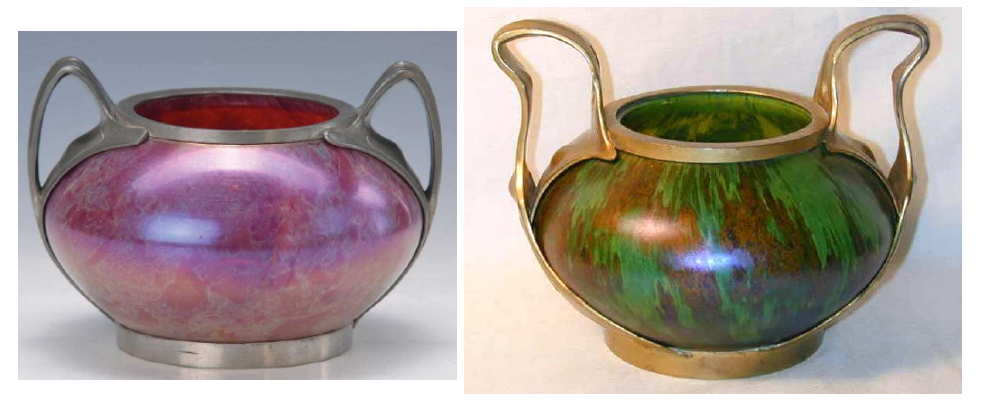
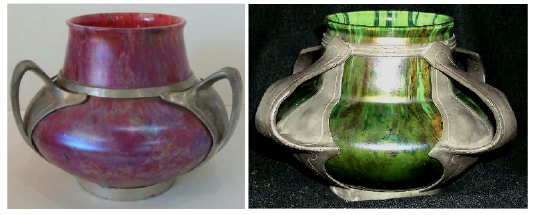
Along the lines of other pieces found in mounts, these two examples appeared at different times. Again the angles and distance the images were taken at are slightly different, as are the mounts. In light of the mounts, the possibility that the shape to fit similar mounts were ordered by the refiner from different firms had to be considered once again. These shapes shown here side by side were also cataloged, and my Welz research continued. Thus far, I had been fortunate in identifying several examples in like shapes, one of which was without a doubt, the Welz patented décor Purple Iridescent. The additional examples in mounts are compared side by side in this image.
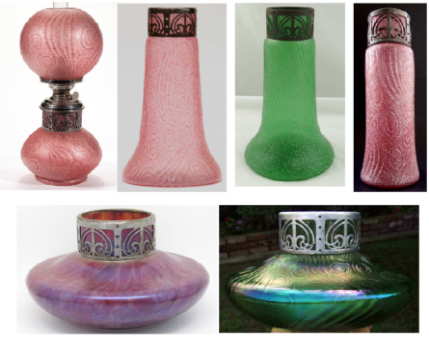
Another clue in my journey to identify Welz production, was a particular metal collar which I had really only seen on examples of their glass. I have to say that I am very leery of using “metal” to identify glass. In this group image, I show examples of Spiraloptisch production by Welz which uses the metal collar I am referring to. As I examined the collar design through the years, what I did find, was that I could not identify the collar as being used on any glass which could be solidly linked to any production house other than Welz. In considering the use of a detail such as this, it is critical to determine if the use of the metal design is widespread, or if it seems narrow, and possibly a proprietary design. Over time I have arrived at the conclusion that the design is more likely than not, to be proprietary to Welz. That collar is shown in this image group.
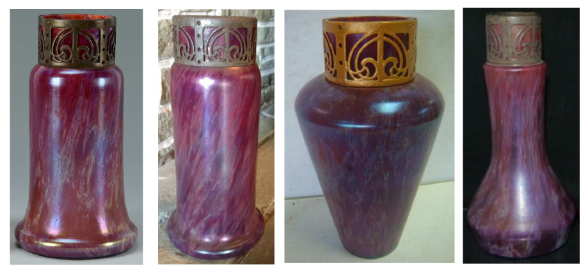
Additional examples of this collar are seen on this group in Welz Purple Iridescent glass.
Having arrived at the conclusion that the collar was used by Welz, this form in Moss Agate presented itself. The form is reasonably simplistic, and quite similar examples were likely made by several firms. The collar on the piece, at least at this point, seemed to point in the direction of Welz. Here is that example.
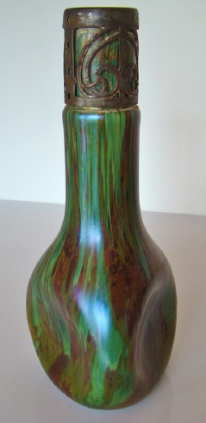
Cataloged as part of my décor study, I moved on from there.
Very early on in my research of Welz production I purchased a vase in the patented Welz décor I refer to as Purple Iridescent. That form is seen in this next image. I have owned the vase for around 10 years at this point, and can say that in all of those years, I have only seen the shape on two or three occasions. Every time I have seen the form, it has been in the same Welz décor as the example I own. My example stands at a touch over 10 inches tall. This is a shape which I would say falls into the second classification of shapes I use and look for in my research. It is a relatively simplistic form, but one that at this point, does not appear to have been used by any company other than Welz.
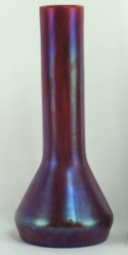
As time moved on, in mid 2021 I received a link in an email from a good friend, to a vase that I was quite shocked to see. She is actually the only other person in the glass world that was fully aware of my Moss Agate study. Although the description said that the vase was 12 inches tall, the shape was one I had only seen in a Welz décor very few times. In recent weeks, I finally negotiated a reasonable price for the example, and it arrived a few days ago. That vase can be seen in this image.
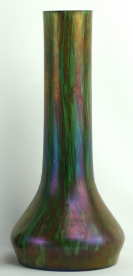
In this image I have re-sized the Moss Agate example to the same height as the Purple Iridescent example for shape comparison, and also have placed an image of the original size next to it.
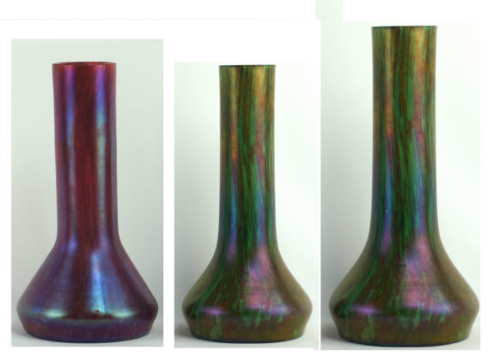
My conclusion regarding Moss Agate, after 5+ years of investigation, is that the decor was actually not manufactured by Kralik, and was in fact, produced by the firm of Franz Welz of Klostergrab.
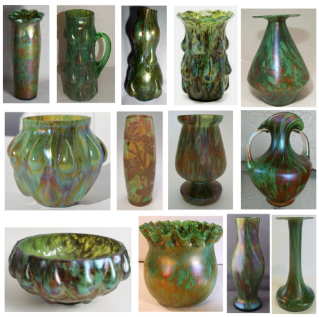
The following image shows a variety of shapes that the Moss Agate décor has been seen in. This is only meant to show other forms for Moss Agate, and certainly not all of the forms the décor is likely to be found on.
.
.